|
|
 |
|
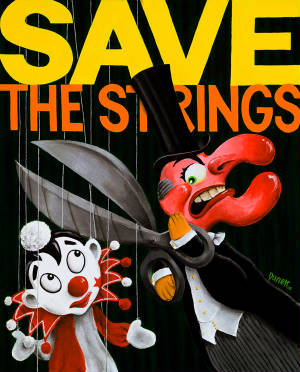
"Save
The Strings," David's contribution to an L.A. theatre benefit. (Click to enlarge)
David Durrett has been a fan of art and pop culture for most of his 44 years.
As a child in the 1960s and early ’70s, he was attracted to the visual appeal of the 1930’s icons who were undergoing
a resurgence of popularity—Laurel and Hardy, the Marx Brothers, the Universal monsters, and others. He began sketching
them, and he has been drawing and painting popular figures and characters every since. In May of this year David opened a public art studio in Jacksonville called
Yes You Canvas! It allows anyone to paint along with him during scheduled or private
group classes every day. Visit the site for more information or call him at (904) 993-9047. David spent most of the previous 12 years as Vice President of Client Service for the Dalton Agency, a full service
ad agency whose clients include almost 350 McDonald’s restaurants throughout Florida and Georgia as well as the Jacksonville
Jaguars, Swisher Cigars, and many others. He graduated from Jacksonville University in 1984, summa
cum laude in Commercial Art, but shortly afterward, all the hands-on graphics techniques he learned gave way to computerized
approaches. That revolutionary change was great for the industry but didn’t appeal to him as an artist, so he moved
into client service.
|
|
|
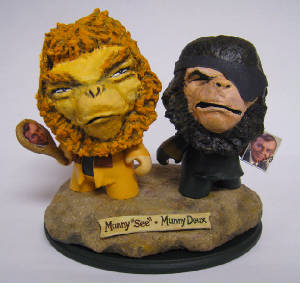
David joined
the Urban Vinyl craze with his award-winning "Munny 'See'/Munny Deux." (Click to enlarge)
David was inspired to start painting regularly again after becoming aware of the surging Lowbrow art movement, which
links artists through a shared collective memory of the symbols of their youth: Godzilla matinees, countless “Planet
of the Apes” sequels and spinoffs, classic Disney toys…all providing vivid touchstones for childhood reminiscences.
Lowbrow appeals to David because it allows him to pay tribute to these memories and try to create some new ones in the process.
His first Lowbrow painting, completed in 2008, plays on a line uttered in the cult Japanese monster movie “The War of
the Gargantuas,” which is an unofficial part of the Godzilla canon. The two Gargantuas are spawned from the same cells,
leading an American doctor to comment on the significance of the “brother against brother” theme in his country’s
past. David imagined the characters in a classic Civil War pose reminiscent of Matthew Brady’s photographs from the
era, and researched uniforms and weaponry to make the painting authentic. The result is “The Brown and the Green,”
a takeoff on the familiar Civil War phrase “The Blue and the Gray.” As a followup, he created a poster-style painting
of the green Gargantua called “Bad Ass”; his famously aggressive, man-eating demeanor fits the description well
and links an old icon to a modern epithet.
As a collector of classic character toys, David has always been fascinated
with the three-dimensional rendering of two-dimensional characters. Part of the Lowbrow phenomenon is the Urban Vinyl movement,
in which Lowbrow artists manage the transition of their own original characters from two dimensions into three. Accessibility
is an important strain running through both movements, illustrated by “blank” vinyl figures that people are encouraged
to paint and decorate themselves, even entering them into contests held by Urban Vinyl toy stores and galleries. David has
participated in shows sponsored by Uberbot in Orlando, most recently a “Munny” contest, in which participants
turn monkey-shaped figures into exotic creations. He won a judge’s award for “Munny 'See'/Munny Deux”—a
tribute to a favorite actor of his youth, Woodrow Parfrey, who was the only performer to play both an orangutan and a chimpanzee
in the “Planet of the Apes” canon. (He was one of the ape judges in the original film, and played a chimp official
in the TV series pilot.) The resulting sculpture was a prime example of Lowbrow: a lesser-known aspect of a classic pop culture
phenomenon rendered as a latter-day tribute using modern media. In an interesting coincidence, Parfrey’s son Adam is
one of the leading figures in underground publishing, a cousin of Lowbrow art. He was very enthusiastic when he saw photos
of the piece, which David gave him as an appreciation of his father’s work.
In late 2008 David received an
email from La Luz de Jesus, a leading avante-garde art gallery in Los Angeles, asking artists for donations to a benefit auction
in early 2009 to save the Bob Baker Marionette Theater from impending foreclosure. As a fan of Baker’s marionettes (he
owns three), David wanted to help in a significant way, and he began work on “Save The Strings,” a poster-style
painting that depicts the clown in Bob Baker’s logo as a marionette whose strings are about to be cut by a scissors-wielding
banker imagined as a classical Punch-style hand-puppet. He hopes the painting will help in the effort to save the landmark
puppet theatre and workshop.
David has enjoyed getting back into art and is grateful for the inspiration of the
Lowbrow movement and its leading figures, including Gary Baseman, Amanda Visell, Tim Biskup, and David Horvath. All of these
artists have enjoyed cross-over success, and David looks forward to the continued exposure of Lowbrow and Urban Vinyl, which
is starting to gain mainstream awareness through culturally-savvy stores like Urban Outfitters.
Over the last year,
David has been amazed by the discoveries painting has led him to make about art and himself. “Painting is a series of
decisions you make,” he says. “I truly think anyone can do it…some people just need some help making those
decisions. It’s truly a ‘people’s art form.’ ”
|
|
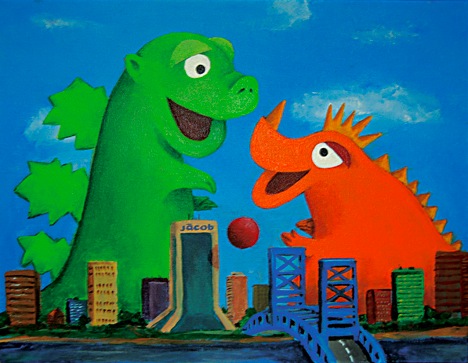
Godzilla
& Co. take a decidedly softer, gentler approach when they descend on Jacksonville to decorate a baby's room.
|
|
|
|
|
|
|
|
|
|
|
|

